

)
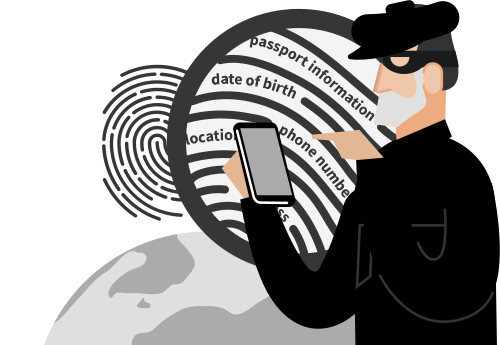
Social engineering, manipulation, and online impersonation have become highly organized, industrialized, and heavily enhanced by artificial intelligence. According to F‑Secure’s Scam Intelligence & Impacts Report 2026 (p. 23), F‑Secure’s internal research shows that 89% of scammers’ AI use focuses on improving the quality of their bait, making it even more challenging for everyday consumers to recognize social engineering tactics.
Social engineering means digital manipulation techniques that target human behavior and trust rather than software vulnerabilities to steal data or money.
Scammers increasingly use artificial intelligence to create highly convincing, error-free bait, making social engineering tactics much harder to detect.
Both individual users and organizations are tempting targets for social engineering attacks. Stay protected with trusted scam protection software.
F‑Secure Scam Protection helps you stay protected from the advanced social engineering tactics used by cyber criminals.
Want to stay safe online?
F‑Secure Total keeps your personal information safe from data breaches and the dark web.
Types of social engineering attacks
Social engineering attacks are tailored based on the attacker’s target and goals. Understanding different digital manipulation techniques used by online criminals is at the core of preventing social engineering attacks.
Type of social engineering | Description |
|---|---|
Deceiving victims via email, SMS or phone calls to steal personal or financial information. Attackers may also use phishing to trick targets into downloading malware-infected files or software. | |
Pretexting | Fabricating a convincing scenario, or a pretext, and impersonating a trusted figure, such as a coworker or authority, to gain the victim’s trust. Once trust is established, the criminal manipulates the target into revealing sensitive information. |
Baiting | Relying on human curiosity by leaving malware-infected physical media, like flash drives or CDs, in public or corporate spaces. |
Honeytrapping | Targeting individuals looking for love online by creating fictional personas on dating apps or social media and tricking victims into sending them money. |
According to F‑Secure’s Digital Trust Report 2026, 84% of respondents are worried AI will make it impossible to tell what’s real online. Educating yourself about social engineering tactics and using trusted security software are ways to stay protected online.
Are you worried about an image or video that you suspect might be a deepfake?
Don’t worry anymore and verify it with our deepfake detector!
How to prevent social engineering
Because social engineering relies on human error, attacks cannot be prevented solely by fixing software errors. Luckily, individual users and organizations can do a lot to prevent social engineering attacks. Here’s how to avoid social engineering attacks:
1. Verify and validate
Before taking action on any unexpected request, make sure to have strict verification habits to protect your data from digital manipulation:
Do not click suspicious links or download sketchy files.
Verify the recipient’s identity before sharing sensitive information.
Never share your user credentials, such as passwords or verification codes, with others.
Restrict administrative rights to limit who can modify network settings or install new applications.
2. Use reliable online protection
Installing an advanced security software creates an automated safety net that catches threats when your own security habits slip:
Protect your devices with reliable online protection, such as F‑Secure Scam Protection.
Always use two-factor authentication on all your accounts.
Update your software regularly to avoid vulnerabilities.
Use a secure VPN when using public Wi‑Fi networks.
3. Stay up to date with new digital manipulation trends
Understanding the evolving psychological tactics used by scammers allows you to proactively stay safe online:
If there are children in your household, educate them about cyber security and best practices for using the internet.
Be careful what you reveal on social media, as your accounts can be mined for information used to manipulate you.
Scam protection for the whole family
Keep you and your loved ones safe from online scams. Try F‑Secure Scam Protection on your mobile devices and computers for free.
How do social engineering scams work?
Most social engineering attacks follow a structured, well-planned pattern:
Information gathering: The attacker acquires background data on potential targets, a process that is usually automated and done in bulk rather than through manual tracking.
Establishing rapport: The scammer approaches the victim through online impersonation and a compelling narrative to build trust.
Execution: Once trust is established, the attacker manipulates the victim into taking a specific action.
Covering traces: The social engineer removes evidence, cuts off communication, and escapes before the victim realizes they have been scammed.
Social engineers are skilled at digital manipulation, often leveraging psychological pressure points, such as a false sense of urgency or online impersonation, to bypass critical thinking. By pulling the right strings, social engineers can make their victims do things that most would consider unlikely — until they become victims themselves.
F‑Secure protects you from social engineering scams
By choosing a trusted cyber security provider, you can protect all your devices and personal data online. F‑Secure Scam Protection keeps you and your family safe from the advanced social engineering tactics used by cyber criminals.
F‑Secure is trusted by more than 30 million people worldwide. Because for 35 years, we’ve made protecting your family’s devices, privacy, identity and online lives easy.
Here’s how F‑Secure Scam Protection works to keep you safe online:

Frequently asked questions about social engineering
Social engineering refers to malicious manipulation techniques used by cyber criminals to exploit human psychology and trust. Rather than exploiting software code flaws, attackers deceive individuals into making security mistakes, revealing personal information, or transferring money.
Yes, online impersonation used to deceive others for financial gain, commit data theft, or harass them is treated as criminal fraud in the US and can lead to severe penalties.
An example of social engineering is a scammer calling and posing as an IT specialist from a well-known company like Microsoft. They claim that they have detected a virus on the victim’s computer. Driven by panic, the victim is prompted to download a remote desktop tool, granting the attacker full access to their machine, files, and bank accounts.
Because social engineering relies on human error and predictable behaviors, no security solution will provide full protection. However, investing in a security software that offers real-time scam tracking, advanced browsing protection, and identification of hidden malware downloads will help you stay protected online. F‑Secure Total is a trusted security solution with all these features.
)